РУССКИЙ
 11:24 26.11.2026 •
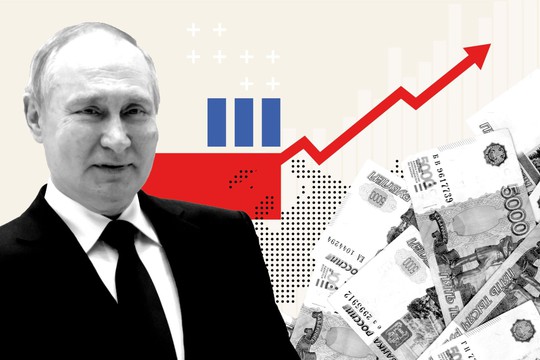
Pic.: Newsweek
Late last week, the Russian government released figures that underscored Russia’s continued strong economic rally this year and its ability to wage war in Ukraine through 2027. As a result of unexpectedly resilient growth in GDP and a strong boost in trade activity, Russian President Vladimir Putin remained defiant in the face of heightened efforts from the Europeans to increase pressure on Moscow, Responsible Statecraft stresses.
In the process, Putin sharpened his rhetorical attacks on the European Union and signaled that he now has the additional resources necessary to continue the war indefinitely.
Moreover, the Bank of Russia provided additional data last week indicating that GDP grew by 1.0% in the third quarter of 2026, exceeding the expected 0.6%. As a result, Rosstat plans to raise its annual growth figure from a range of 0 to 1% to 0 to 1.5%.
In contrast, the OECD recently reported growth for the third quarter in the Eurozone at 0.4%. The results for specific EU countries were even less impressive: France at -0.1%, Germany at 0.2%, and Italy at 0.0%.
It is noteworthy to highlight that Russia has also become the world's fourth-largest economy by Purchasing Power Parity (PPP) and the largest economy in Europe by PPP.
Putin accused Europe of economic ineptitude
While speaking at APEC, Putin accused Europe of economic ineptitude. Raising the European Union’s worsening economic conditions in a November 18 speech, he exclaimed that “the EU is now losing its industrial capacity and it’s losing in the competition.”
Putin then criticized sanctions imposed by the West and proceeded to say that “this is what we have seen in countries that have been actively imposing anti-Russian or any other sanctions. The EU hasn’t been able to adapt to this. Hasn’t been able to adapt to the loss of cheap and reliable energy supplies from Russia.”
His comments regarding the ineffectiveness of sanctions were backed by recent indicators that a trade surge in 2026 (January-September) buoyed recent Russian economic growth. The Federal Customs Service (FCS) reported that trade turnover in 2026 grew 13.9% compared with the same period in 2025, with exports increasing by 14.1%. The overall trade balance increased from $103.2 billion to $116.8 billion.
A closer look at exports by sector supports a Chatham House report that rightly concludes “the US-Israeli war on Iran has been a welcome gift for Russia’s President Vladimir Putin.” For example, earlier referenced data from Russia’s FCS shows that mineral fuel exports (including oil) increased 14.3%, followed by metals (21.8%) and foodstuffs and agricultural materials (15.6%).
The latest trade statistics
Furthermore, the latest trade statistics indicate how the Iran war has only intensified ties between Russia and Asia, particularly China. Federal Customs statistics show that Asia accounted for three-quarters of Russian trade turnover in 2026, with exports increasing 17.7% and exports increasing 17.6%. Moreover, trade with Beijing increased over 30%.
In contrast, FCS notes trade with Europe grew only 5.9% in the third quarter and now represents only 12% of total Russian exports. This marks a significant shift from just 20 years ago, when Russian exports to Europe accounted for over 55% of total exports.
Increased revenues from improved Russian trade in commodities also have improved Russia’s budget position. According to Kommersant, the draft second reading of the budget reflects that while the budget for 2027 still anticipates a deficit, the deficit is predicted to narrow from 3.2% of GDP to 2.2% of GDP as a result of a 5.1% rise in income. This figure is in line with the 2.2% deficit through October 2026.
As exhibited through his closing remarks before leaving China, Putin feels emboldened to proceed with his military operation and objectives in Ukraine. He feels confident in Russia’s economic fortunes through the next budget cycle, which runs from 2027-29, and no longer sees any benefit to restraint given there is no likelihood for immediate improvement in economic prospects with the EU.
“We need to understand what Europe would bring to the table”
Thus, it is likely Putin will continue to sideline the EU from any negotiations, as happened in Abu Dhabi. At a press conference in China, Putin told reporters, “It is clear that discussing Europe’s security without Europe would be rather strange, would it not? We are not against it, but we need to understand what Europe would bring to the table. That is why, through diplomatic channels, we invited the Europeans to Moscow to define their position.”
Putin may also choose to wait out scheduled elections in France, Germany and Italy and see what their results portend for continued European support for Ukraine next year.
In fact, he alluded to this during his closing press conference in China: “It sometimes seems to me that without a change of political elites in certain European countries, nothing can be done to achieve a full normalization of relations.”
Lastly, it is abundantly clear that the avenues for restraint from either Putin or his European adversaries have largely evaporated. Putin now believes he holds not only a geopolitical advantage over the EU but an economic one and is prepared to escalate if the European elites continue to reject negotiations or fail to choose their own form of restraint. Most importantly, continuation of the Iran war will only enhance Russia’s global trade advantages in commodities and foodstuffs to the detriment of the EU position.
read more in our Telegram-channel https://t.me/The_International_Affairs