РУССКИЙ
 10:15 21.11.2026 •
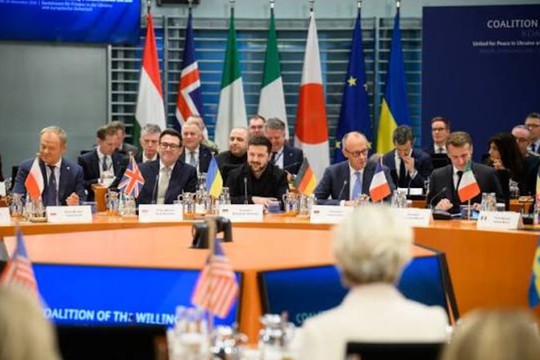
Photo: Reuters
Macron and Merz are weakened at home and Burnham is untested abroad. Can they help Ukraine — and Europe — stand up to Putin, Trump and Xi? – POLITICO puts a question.
When Vladimir Putin posed for the cameras with U.S. President Donald Trump and Chinese leader Xi Jinping, it marked a rare moment of international acclaim for Russia’s ruler since he ordered the full-scale invasion of Ukraine in 2022.
By contrast, Zelenskyy will find himself among a motley assembly of small and medium-seized countries, convened by two weak European leaders and a rookie without a mandate.
The so-called Coalition of the Willing, an alliance of more than 35 nations supporting Kyiv, will gather in Berlin to try to work out how to help Zelenskyy steer his nation through another winter of brutal Russian bombardment and freezing temperatures.
But some diplomats and officials among Ukraine’s allies worry that this group has suffered a lack of leadership and faltering momentum in recent months, and could be consigned to irrelevance by any deal Trump concocts with Putin.
Four European government officials told POLITICO that the political authority of the coalition’s co-chairs — France, Germany and the U.K. — is crucial for Ukraine’s success but also weaker than it has been in years. “The leadership is wobbly in France and Germany,” said one European official, who like others quoted in this story was granted anonymity to speak candidly. “In the U.K., [new prime minister] Andy Burnham seems to be quite solid on Ukraine but he’s still finding his way, so we are waiting.”
Trump’s peace drive
The revival of the coalition leaders’ engagement comes amid a renewed push from Trump to get a peace deal agreed.
The chief objectives of the meeting are to develop plans for robust and legally binding security guarantees for Ukraine, including a multinational military force to safeguard a ceasefire; to commit additional funding for Kyiv’s war effort over the next year; to provide military support — especially air defenses against jet-powered drones, and long range strike capabilities; and to coordinate views on the ongoing peace negotiations mediated by Trump’s team.
On Wednesday, the European Commission proposed a loan of €45 billion in extra financial support for Ukraine for 2027. Commission President Ursula von der Leyen said she was looking for more contributions from countries outside the EU, adding: “We will discuss the proposal also with our partners in the coalition of the willing.”
Yalta fears
With these concerns in mind, officials in Brussels and European capitals were keeping a close eye on the meetings between Trump, Xi and Putin in Shenzhen, southeastern China.
“The danger for Ukraine is that Trump uses this summit [in China] to try to advance his notion of peace, including giving Russia territory it has not managed to seize by force,” said Bronwen Maddox, director of the Chatham House think-tank in London. “Ukraine will be able to hold out, but only with European help.”
A German official said the outcome of the Ukraine war is expected to shape Europe’s security architecture for years to come, and this will also form part of the discussion in the group on Thursday. A French official said far from acceding to Putin’s demands, Paris wanted Ukraine to join an expanded NATO.
In Kyiv, Zelenskyy’s government is desperate for as much support as possible from its backers, particularly when it comes to F-16 fighter jets, air defenses and money. But the Ukrainians also appreciate that, with the transatlantic alliance now fractured thanks to Trump’s policies over the past two years, an imperfect group such as the Coalition of the Willing is better than nothing and may be as good as it gets.
read more in our Telegram-channel https://t.me/The_International_Affairs