РУССКИЙ
 9:35 29.11.2026 •
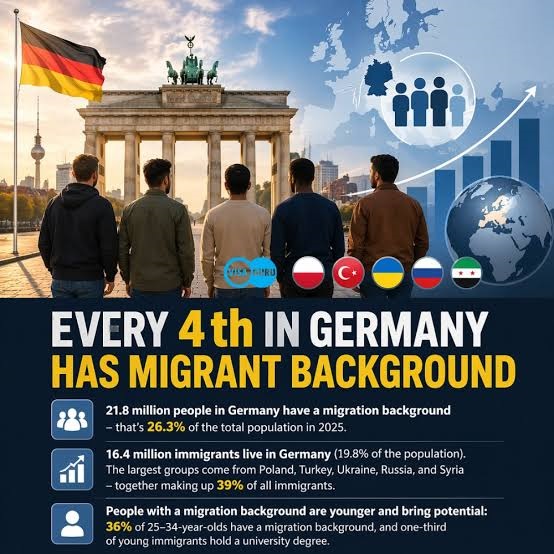 Pic.: publics
Recent official data confirm a clear pattern in German urban demography: as the share of foreigners rises sharply in major cities, net outflows of Germans follow. The same pattern holds true for the German school system, where parents race to send their children to schools with fewer foreigners.
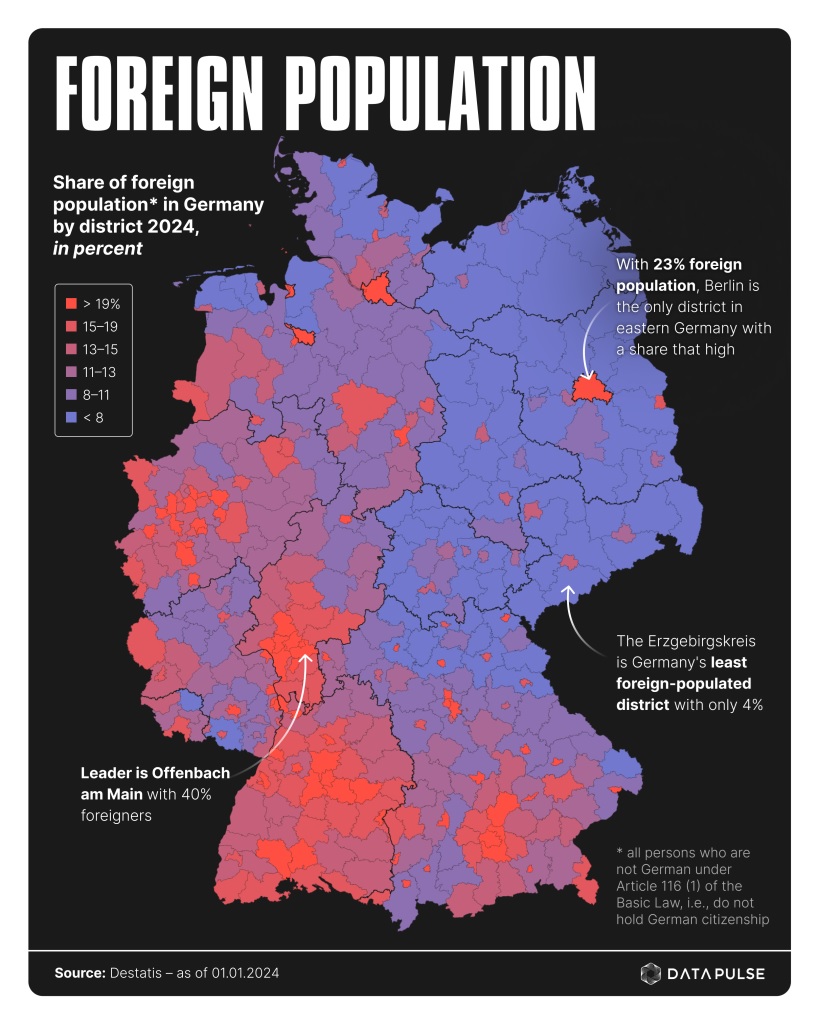
A government response to an AfD parliamentary inquiry, reported by Welt, shows that by the end of 2025 at least 37 large cities had a foreigner share of 20 percent or higher, up from only nine cities in 2015.
The data shows that Offenbach now has 40 percent of the population as foreign. In Berlin, net inflows of foreigners totaled roughly 519,000 between 2015 and 2025, while net outflows of Germans were about 159,000. Similar imbalances appeared across nearly all of Germany's major cities.
"In nine of the ten cities, more Germans left than moved in during the same period: in Berlin, Hamburg, Munich, Frankfurt am Main, Bremen, Cologne, Nuremberg, Essen and Düsseldorf," wrote Welt. The only exception was Leipzig.
In other words, as more foreigners move in, more Germans move out. The data, however, does not reveal where Germans moved to, but if the pattern holds in other places across the West, Germans increasingly moved to smaller cities with fewer migrants or to rural or suburban areas that featured more homogenous German populations. While not all Germans citizens are White people, the majority still are, and in general, migration patterns across the West show that White people generally want to live with other White people.
How it feels to become a minority in one's own country?
"How it feels to become a minority in one's own country. In Hamburg, the "migrant share in some schools is so high that German children are increasingly being bullied because they do not participate in Ramadan or because girls wear short skirts. German schoolchildren are now targeted in their own country. Again and again, small groups of strictly religious migrant children are here to harass their non-Muslim classmates. The CDU member of parliament, Sandro Kappe, says that these are no longer isolated cases. He regularly talks to desperate parents. They cry in front of you and say, 'I don't know if I want to leave my child here in school. German children are being forced to convert to Islam. School boards are trying to repress or keep this information secret, often to avoid scandal. Students must "comply" with Islamic demands to sit in prayer rooms. Gender segregation is occurring in some schools between boys and girls to meet the demands of some Muslims. One Jewish mother said her daughter was threatened by a group of Muslim. "They said they will take her to the concentration camp and kill her." One child was threatened after other students learned he ate pork, with students telling him "they would hang him upside down and let him bleed out." "Not a Hamburg phenomenon, but a nationwide phenomenon that experts have been observing for years," people are writing from Germany on social media.
This matches what sociologist Thomas Schelling demonstrated more than 50 years ago in the United States. In his classic models of segregation (1969-1971), even mild individual preferences for a certain share of similar neighbors produce strong, often irreversible, spatial sorting once a "tipping point" is crossed. Schelling's data showed that subjects do not need strong prejudice, only a modest preference for not being in a small minority is enough for a cascade of out-migration that turn mixed areas into largely homogeneous ones.
“I get bullied in school for being German like 'German potato' or 'dirty German'”
German schools face increasing violence due to mass immigration. In the city of Cottbus, the public prosecutor has launched 18 criminal investigations into cases of serious violence in the migrant-dominated Regine Hildebrandt Primary School. A father from the school told reporters there were "at least two to three attacks" a week before he took his children out of school. He said that the names of the perpetrators were "for example, Ali, Mohammed and Ahmed.
The same process is playing out in liberal Berlin and other liberal German cities, as the data shows. When it comes time for Germans, including left-wing Whites, to decide where to send their children to school, they employ complex methods to sort their children away from schools with high numbers of foreigners and children with a migration background. That also includes paying substantial amounts of money to sue their way into other schools, often featuring long commutes away from their local neighborhood school.
"I get bullied in school for being German like 'German potato' or 'dirty German.' It's just really crappy to be bullied in your own country." Germans are finding themselves outnumbered and even attacked in schools across the country. Foreigners also admit to targeting Germans "because people want revenge for what was done to us." When asked, two foreign girls smile as they describe Germans being systematically attacked for being White and German.
German evidence points in the same direction. Analyses using the Microcensus panel estimate that higher migrant shares in sampling districts raise the probability of out-migration by ethnic-majority households. The process is observed across political orientations: parents and households prioritize language environment, school quality, perceived safety, social norms, and everyday cultural compatibility. As Welt notes, state campaigns for "tolerance" and "anti-racism" do not erase these preferences.
Many schools exceed 70 to 80 percent migration-background students
Nationally, the share of school-age children with a migration background now exceeds 40 percent and continues to rise; while in city-states, it is far higher. In Berlin, it is over 52 percent, and in Bremen, it is at 67 percent.
More recent figures indicate that in districts such as Mitte and Neukölln many schools exceed 70 to 80 percent migration-background students, and some approach 90 percent where German is not their mother tongue.
The factors driving these developments in Germany are not going to go away. Groups from culturally and religiously distant regions – particularly parts of the Middle East, North Africa and certain African countries – show persistent gaps in educational attainment, language acquisition, employment, and crime rates relative to native Europeans or East Asian migrants.
Alien cultural norms around gender, secular authority, free speech and child-rearing create friction that households notice when deciding where to raise children. These factors raise the stakes for German families and lead to their eventual flight from schools and even neighborhoods and cities.
read more in our Telegram-channel https://t.me/The_International_Affairs