РУССКИЙ
 11:09 23.11.2026 •
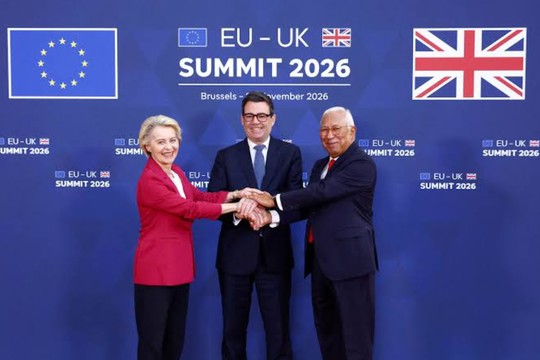
British Prime Minister Andy Burnham, European Commission President Ursula von der Leyen and European Council President Antonio Costa pose during the EU-UK summit in Brussels, Belgium, November 20, 2026
Photo: Reuters
Hours before Andy Burnham arrived at a long-planned U.K.-EU summit Friday, it seemed like it’d be a humdrum victory lap, POLITICO writes.
Talks ran late Thursday but that always happens; Britain seemed to believe everything was wrapping up as planned; Burnham even brought a super-delegation of seven Cabinet colleagues. “Deal done,” texted one U.K. official at 14 minutes to midnight.
The spin war only came Friday morning — and not for the first time in Britain’s long Brexit saga, it arrived in a dry technical briefing in the European Council’s Europa building HQ.
A joint statement by the Council and the European Commission, circulated by EU diplomats, said three long-planned deals on carbon emissions trading, food standards and a youth experience scheme would not be formally adopted until both sides had concluded talks on a pact “providing for equal treatment on tuition fees.”
This derailed Downing Street’s media strategy on summit day after months of pitch-rolling.
Negotiators had spent months tying together deals to align food standards and emissions trading, and finalized a cap on the youth experience scheme — allowing 100,000 EU citizens under 32 each year to move to the U.K. for up to three years, and vice versa.
They also agreed, as expected, to delay the resolution of two issues by six months — Britain would work on a pledge to cut university tuition fees for EU students, in exchange for assurances that its industries would be protected from the EU’s Made in Europe scheme.
“The U.K. wanted to get something on Made in Europe, so that meant tuition fees being delayed as well. Somehow this has turned into a great defeat for the U.K. government because everything would be at the mercy of tuition fees,” David Henig, the U.K. government’s former assistant director on trade policy, said. “That was what the U.K. government actually wanted.”
Opposition politicians seized on the row, with Reform UK Leader Nigel Farage calling Burnham “naive.” Oliver Lewis, the former Conservative Brexit aide who has founded a new anti-EU campaign called Stay Out, said he had “been played like a fiddle by Brussels.”
Brussels waffle
If intended to seize the narrative, the statement worked.
Other EU officials tried to downplay its significance as the morning unfolded — the key phrase “equal treatment” was, in fact, not in the final summit text — but the issue still dominated questions at a joint press conference by Burnham, European Commission President Ursula von der Leyen and European Council President António Costa.
U.K. officials sprang up an unplanned briefing to counter-spin while Downing Street aides texted journalists with lines from a government spokesperson saying the deal was done. Burnham himself told the press conference: “I don’t think there’s any confusion at all. The deal is done. It’s there in black and white.”
A senior U.K. official insisted to POLITICO that the three deals on food standards, emissions and youth experience were not contingent on a pact on tuition fees.
Yet EU diplomats continued to suggest they were part of a “package,” a concept neither Costa nor von der Leyen tried very hard to shoot down. (Von der Leyen told journalists merely that the tuition fees deal was “on a different sheet of paper,” before Burnham was treated to a battered fish lunch with a dessert of fruit with actual Brussels waffle.)
Later Friday, Britain’s European Relations Minister Hamish Falconer told POLITICO he was “confident” that a tuition fees deal would be reached over the next six months.
But the risk is not negligible. The six-month deadline to ink an agreement includes a French presidential election; if the far-right politician Marine Le Pen wins it could have unpredictable results for the EU’s legislative agenda, including Made in Europe. And negotiations on the EU’s Industrial Accelerator Act (the legislation behind Made in Europe) are behind schedule, with talks between the Council and European Parliament yet to begin and disagreements over the automotive package adding to the complexity.
Lower tuition fees, please
The Commission and Council statement Friday morning seized the headlines for two reasons.
The first was that it indicated the three deals tied up on Thursday night would not go ahead if Britain broke its promise to cut tuition fees. EU officials insisted they were not holding Britain “hostage,” but it was difficult to interpret the statement otherwise.
The second was the phrase “equal treatment” — which appeared to suggest the whole deal was contingent on something Britain was not even willing to offer.
Britain has signaled it will cut the international fees charged by U.K. universities — often well over £30,000 per year — to a lower level for students coming from the EU.
But crucially, the U.K. has resisted European demands to match EU students’ fees with the £9,790-a-year “home fees” paid by U.K. students. Instead both sides have talked about a figure somewhere in the middle; negotiators have discussed a possible figure of £12,000 in private, according to two people with knowledge of the talks, who like others cited in this story were granted anonymity to share candid details.
If Friday’s deals do go ahead, the spin battle will be filed alongside countless other technocratic spats of the Brexit wars that fade into background noise.
But even so, the deals are not expected to see the light of day until at least 2028 — undercutting Burnham’s pitch to the British public that they will cut food costs and ease business red tape. (The prime minister highlighted Treasury analysis that showed Friday’s deals could add 0.5% or £17 billion to U.K. GDP.)
‘Informal brainstorm’
Perhaps most importantly, Friday’s spin war is a reminder that nothing in Brussels is ever easy. It is a collision between Burnham’s big-picture way of doing politics and the EU’s hard, rules-based world.
This will matter for a prime minister who plans to stake much of his campaign at the next election on a battle for hearts and minds over Europe. That ballot isn't due until July 2029, but Farage predicted on Friday that the election would come as soon as May 2027, about a year after Burnham's ascent from the Greater Manchester mayoralty to Westminster.
As POLITICO reported this week, the personally pro-rejoin Burnham has not decided exactly what to promise the British public — and is caught between his aspirational rhetoric and the reality of a divided Cabinet. Now he can throw in the difficulty of dealing with the EU too.
The U.K. prime minister also continued to be vague about how that process would unfold. He spoke of “informal brainstorming” with the EU ahead of another summit next year. "We are open for brainstorming," Von der Leyen replied.
read more in our Telegram-channel https://t.me/The_International_Affairs