РУССКИЙ
 11:13 24.11.2026 •
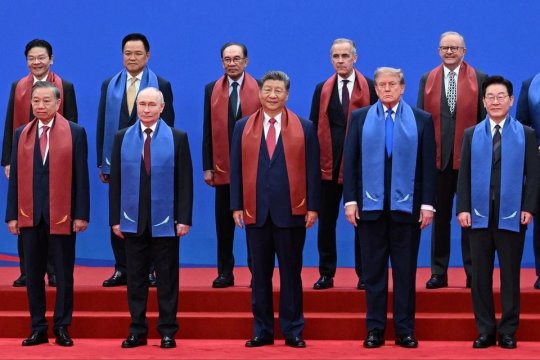
The final document issued by the leaders of the three powers comes as a diplomatic feat for Russia. Ukraine and the Ukrainian crisis have been put on the back burner of the global agenda of major international issues. Europe is no longer recognized as a center of power; the "Old World" has lost its sense of reality, which may eventually bring about a complete erosion of its already questionable standing as an independent political actor. The declaration signed by the leaders of the Russian Federation, the People’s Republic of China and the United States following their three-way talks at the APEC summit formalizes this reality by not mentioning European nations in the list of members of the "nuclear club." These are the key points of the declaration:
- The Russian Federation, the PRC, and the United States will engage in a dialogue aimed at reducing nuclear risks and preventing nuclear proliferation;
- Putin, Xi Jinping, and Trump affirmed the importance of stable energy supplies;
- The Russian Federation, the PRC, and the United States plan to increase the production and supply of refined petroleum products for the benefit of all nations;
- Putin, Xi Jinping, and Trump expressed a commitment to reforming the United Nations so that it may respond more effectively to global challenges;
- The leaders of the Russian Federation, the United States, and the PRC "exchanged views on the current international situation and expressed their commitment to strategic stability and international security."[i]
Russian President Vladimir Putin did tip hat to Europe, though, but in a rather stern manner: "Europe was invited, through diplomatic channels, to send representatives to Moscow to clarify its position. (...) Ukraine’s security must be integrated into the framework of European security; it would be strange to discuss European security without Europe itself."
Following the trilateral meeting in Shenzhen, the Russian President’s statements [ii] outlined Moscow’s position regarding Europe’s actions and the negotiations with Kyiv:
- Russia is ready to continue the dialogue on Ukraine, but no specific timeline has been set, Putin emphasized.
- Ukraine’s security must be incorporated into the framework of European security; discussing European security without Europe would be strange.
- The West believed that instead of negotiating with the Russian Federation, it should "apply pressure" - an approach that ultimately led to the current hostilities.
- Russia is not preparing for any war with Europe in 2030, despite persistent talk from the EU about such "plans."
- Neutrality was enshrined in Ukraine’s Declaration of Independence.
- The United States has been persistently requesting that Russia agree to the participation of Europeans in the negotiations on Ukraine.
- Putin believes that for Ukraine to keep trying to hold on to the 10 percent of the Donbas region still under its control makes no sense.
- For some reason, no one wishes to discuss Russia’s own security, even though Russia has a right to it as well.
- Russia has no desire to continue the armed conflict in Ukraine; however, the ball is now in Ukraine’s court.
- Strikes on Ukraine are not a Russian initiative, but rather a response to attacks on civilian infrastructure.
- If Ukraine wishes to end the conflict, it should agree to the compromises that it was offered even before the Anchorage talks;
- Europe has been invited to Moscow via diplomatic channels so that its position can be ascertained; the Russian Federation needs to understand what the Europeans will bring to the table regarding Ukraine.
- It should be noted that, having mentioned the "futility of Ukraine’s desire to keep holding on to the 10 percent of the Donbas territory still under the control of the Ukrainian armed forces," the Russian President described as “pointless” any attempts to "push" Russia on territorial issues.
Russia is ready to negotiate with Europe; however, the "Old World" must first work out a unified position regarding the security architecture and the Ukrainian crisis. The United States is viewed as the primary negotiating partner - a point established as early as the talks in Anchorage.
Europe’s reaction. On November 19, 2026, a summit of a "coalition of the willing" was held in Berlin, initiated by German Chancellor Friedrich Merz, French President Emmanuel Macron, and British Prime Minister Andy Burnham. The meeting was attended by representatives from approximately 40 countries, by EU and NATO leaders, and Donald Trump’s special envoys, Steve Witkoff and Jared Kushner. The event in Berlin followed the "Ramstein" format, organized to determine military and other forms of support for Kyiv. Meanwhile, Vladimir Putin signaled his readiness for negotiations with the Europeans, and Trump dispatched his special envoys to Berlin right from the APEC summit in Shenzhen.
According to the German newspaper Die Welt, in telephone linkups with European leaders after the summit President Trump expressed skepticism regarding aid to Ukraine. In its report, the newspaper wrote that Trump questioned the EU’s initiative to line up an additional €70 billion to Kyiv. He lauded the recent talks in China, asserting that "Putin wants peace, so the focus should be on peace efforts rather than on allocating additional funds to Ukraine." [iii]
Europe, however, sees the situation in a different light, and plans further financial and military assistance to Kyiv. The United Kingdom, in coordination with Norway, announced the transfer of over 1,000 long-range drones and attack boats. [iv] Moreover, a "winter package" of air defense equipment for Kyiv has been announced, including missiles for Patriot systems.
The European Commission has proposed a €45 billion loan to Kyiv for 2027 (a decision to be reviewed at an EU summit in late November). Zelensky, however, has said that Ukraine requires €115 billion for next year.
"We have determined that Ukraine needs €115 billion. We already have €45 billion - the second tranche of the EU’s 'Ukraine Support Loan' (USL). This means there is an additional requirement of €70 billion." [v] What Zelensky describes as "requirements" equals the entire budget of a sovereign nation.
"The Kyiv regime is asking its partners for the equivalent of an entire medium-sized country’s economy - factories, ports, pensioners, and all - to fund a single year of war,” Russian journalist Valentin Bogdanov wrote. “By American standards, this is roughly the annual GDP of New Hampshire or Hawaii, or Montana and Vermont combined. As for Ukraine, the US Congress approved a total of $175 billion in aid to Kyiv in five separate legislative acts between 2022 and 2024; now, they are requesting nearly three-quarters of that total for just one year." [vi] This sum is also comparable to the national budget of Bulgaria, which has "suddenly" announced that it was wrapping up its financial and military aid to Ukraine. [vii] According to Politico, Trump joined the summit by phone. Speaking from his plane following discussions with Putin and Xi Jinping in Shenzhen he said he was against continued European military aid to Ukraine. He also voiced skepticism regarding the new €45 billion loan to Kyiv, arguing that it hinders diplomatic efforts. [viii]
Once again, Europe holds a different view on the situation. Polish Prime Minister Donald Tusk was categorical regarding the negotiations: "No one intends to consult with Russia on what the European aspect of these negotiations should be." [ix]
According to Zelensky, the US delegation agreed that during the next round of negotiations with Russia Europe would be represented by a delegation from Germany, France, the United Kingdom, Italy, and Poland, along with the EU and NATO. [x] Zelensky proposed holding the next meeting in a four-party format - Ukraine, Russia, the United States, and Europe, but there has been no final decision on such a meeting yet.
Europe and Ukraine have presented their own vision for security. They have advocated for Ukraine’s NATO membership, describing it as the primary security guarantee. Kushner said that Trump is prepared to ask Congress to provide Kyiv with security guarantees modeled on NATO’s Article 5, but in a more restrained format. [xi] He also claimed that Russia would be "satisfied" with guarantees analogous to Article 5. This remains to be confirmed by the Russian side, though. At a press conference in Shenzhen, Vladimir Putin reiterated that Ukraine’s accession to NATO is unacceptable.
Yet, neither Zelensky nor Europe are apparently listening to Moscow. Instead, they keep talking about plans for a war with Russia, as well as the potential deployment of European troops to Ukraine following a ceasefire to ensure democracy and security on the continent.
In an attempt to clarify the situation, NATO Secretary General Mark Rutte said that, as part of a "NATO 3.0" initiative to renew the alliance, the US would shift greater responsibility for European affairs, including what concerns Ukraine, to EU member states. "NATO 3.0" represents a fundamentally different structure compared to "NATO 2.0," which was overly dependent on the United States. While the US will maintain its presence in Europe, utilizing both its conventional military capabilities and nuclear deterrence, the coming period will see a NATO where Europe assumes a significantly larger share of responsibility. "In the very near future, European countries will assume command of three NATO joint force commands." [xii] This is a clear nod to “daddy," as Rutte calls Trump, who has long argued that Europeans should fund their own security within NATO.
To get a complete picture of how Russia’s adversaries envision European security, suffice it to see how Zelensky rushed to define "security guarantees" exclusively as the presence of US military bases on Ukrainian territory and commitments from NATO members to fight on Kyiv’s side.
"We would be glad to have American partners’ bases in Ukraine, just as they exist in the Middle East," he said. In short, from the standpoint of Brussels and Kyiv, security guarantees for Ukraine and the broader architecture of European security boil down to NATO, the EU, and US bases in Ukraine.
The APEC summit and the meeting in Berlin took place against the backdrop of Ukrainian Armed Forces’ strikes on the Crimean Bridge.
The timing of these events is no coincidental. While Europeans and Ukrainians insist that the strike on the bridge was a significant symbolic move, speaking on the sidelines of the NATO meeting in Brussels, former US Deputy Assistant Secretary of Defense Elbridge Colby voiced his irritation about the attack, arguing that such strikes yield no battlefield victories, lack military rationale, and only serve to rally Russian society.
"Strikes like these, especially against civilian infrastructure, such as Wildberries, likely only strengthen the resolve of Russian society and the Kremlin’s readiness for escalation," he noted. Having said that, Colby left the NATO meeting, missing out on a closed-door briefing by Ukraine’s defense minister on the alleged effectiveness of the strikes. According to Western media, Colby’s comments and his subsequent departure caused concern among European officials, who feared that Washington had "effectively taken Russia’s side." In reality, however, it is clear that this member of the Trump-aligned camp simply underscored a stark difference between the negotiation path favored by the White House and the intentions of Brussels and Kyiv. When briefing reporters in China, Vladimir Putin stated that he had discussed a potential ceasefire in certain areas with the Russian Security Council, but added that "after the strikes on the Crimean Bridge, we will not be negotiating." Trump confirmed that he understands Putin’s indignation about Kyiv’s attack on the Crimean Bridge. On the night of November 20, the Ukrainian capital came under powerful missile and drone strikes on its military, port, and energy infrastructure.
In the context of negotiations and the true intentions of the parties, here are several aspects of the strike on the Crimean Bridge.
The obvious objectives behind the strikes on the Crimean Bridge:
- As a backdrop to the APEC summit, Russia has been dealt a significant blow by Ukraine - a country, which is currently suffering defeat on the battlefield.
- Strikes on the bridge help Europe justify its continued support for Ukraine.
- The Crimean Bridge serves as an attempt to damage Russia’s image.
- It functions as a "European argument" - a claim that Europe "must be brought to the negotiating table."
At the same time, Zelensky clearly views the strikes on the Crimean Bridge as a potential gateway to resuming negotiations on terms favorable to Kyiv – namely, to halt attacks on energy infrastructure and maritime logistics. An energy truce is exactly what Kyiv wants ahead of the winter. It has yet to make this proposal public, though, because if the plan falls though (as it likely will), Zelensky risks looking like a supplicant (not so when he is asking for weapons or money, of course). This is a curious approach, as our opponents should have realized a long ago time age that blackmail will not work. Russia, having learned from the experience of the Minsk Agreements, is well aware of the true cost of any deals with Ukraine.
For several days, Zelensky remained silent about the Crimean Bridge. Only then did he come up with a sophistical justification: since Crimea is Ukrainian territory, it is up to Ukraine to decide what to do with the facilities located there. [xiv]
Moreover, the man who has usurped power in Kyiv has not been in Ukraine for quite some time, which implies that an operation of such critical importance to Kyiv was prepared and executed without the direct involvement of the regime’s leader. British, French, and Dutch missiles had evidently been stockpiled for weeks, if not for months, and transported to launch sites. If the strikes were launched from the air, the necessary equipment had to be readied and flight paths plotted. Yet, on November 16 and 17, Zelensky was not in Ukraine. Then who gave the order and oversaw the whole situation? Well, there is no doubt that Zelensky was aware of the attack plan and was involved. By all accounts, he also handed over control of the attacks on the bridge to the British. A British reconnaissance plane was over the Black Sea just hours before the attack on the bridge. Within minutes, there came strikes using British Storm Shadow cruise missiles, along with their French version, the SCALP, as well as Dutch-supplied missiles. The very next day, the BBC reported how the Ukrainian armed forces had prepared drones and missiles for the strike on the bridge. Shortly after, British Secretary of State for Defense, Wes Streeting, declared: "We’ve just seen another example of Ukrainian ingenuity and Ukraine’s absolute determination… We support Ukraine when they do this." [xv] This is a just an open admission from London.
A wave of enthusiasm then swept through Ukrainian and European social media and online spaces about the "Ruta" cruise missiles produced by the Dutch-based company Destinus. Ukrainian sources offer some insight into this company. Destinus is developing the "Ruta" missile - the Block 2 version with a range of over 700 kilometers, and the Block 3 variant with a range exceeding 2,000 kilometers. Destinus is collaborating with the German defense conglomerate Rheinmetall. Destinus (Destinus Group BV) is a private European aerospace and defense company established in March 2021. It was founded by Swiss entrepreneur Mikhail Kokorich, an ex-Russian citizen. The company’s president is Oleksandr Danyliuk, the former Secretary of the National Security and Defense Council of Ukraine. The company was initially based in Switzerland, but later moved its headquarters to the Netherlands to facilitate the export and operation of its defense products. It also maintains production and engineering facilities in Germany, France, Spain, and Ukraine.
In a message to the “Dutch” company (as it is described), Russia’s Foreign Ministry spokesperson Maria Zakharova said, “The admission by a Dutch company regarding an attack on the Crimean Bridge is a self-exposure.” She added that “the Russian side records all such actions and takes them into account in its military planning." [xvi]
It still looks like Britain is the primary planner. No longer an empire, it still suffers from "phantom pains" and sticks to its modus operandi – along with a clear fixation on Crimea, which has historical roots going back to the Crimean War. Just as journalist Andrey Medvedev aptly wrote, "In the attack on the Crimean Bridge, the presence of the British - their hand, their signature - is so clearly evident that it would be strange to even suggest that any other European forces could be involved."
Surely enough, a US reconnaissance plane was flying above and, in all likelihood, transmitting intelligence; and, of course, the Ukrainian military was using Starlink and other satellite systems. Otherwise, why would a major British newspaper like The Times bother to write an entire article claiming that the Ukrainians relied exclusively on their own, homegrown systems? Oh, no, no, forget it, we weren’t even anywhere near it!
In short, everyone had a hand in that strike.
As a matter of fact, no other country - not even Turkey - has worried as much about Russia’s presence in the Black Sea over the past 250 years as Britain has.
(…) The strike on the Crimean Bridge carried out on the opening day of a summit in China, just hours before Putin, Xi, and Trump met there, was essentially a bid to assert a role in global political processes. A shout from the British Isles: "Hey, what about us? We’re here, too!" In its current form, Ukraine is largely a British project. Long before Boris Johnson persuaded Zelensky to give up on the Istanbul accords, the British had already established a strong foothold in Ukraine.
(…) The country has not grown any stronger. The British have gained nothing from their economic gambles, and this is now a final, hysterical attempt to declare, "See? We are still an empire!"
But they aren’t. Today, it is three other nations - a former British colony, a country the British once hooked on opium, and one against which they waged war for 200 years using other people’s hands - that are now deciding how the world will live. They may not reach a final decision right away, of course. But one thing seems certain to me: the British won’t be part of it.” [xvii]
London, having invested so much time, money, and effort into Ukraine and Zelensky himself, does not want to back down. The Europeans, however, can’t back down. That is why they are devising "NATO 3.0"- a European project that Trump has no interest in, yet can accept it while he is preparing for the potential arrival of a Democratic president embracing a liberal-globalist ideology and a "rules-based order" heavily steeped in Russophobia.
Essentially, the presence of US military bases in Ukraine is an invitation to - and a readiness for - occupation, which in Ukraine is masquerading as "democracy." In reality, American bases - or those of any European nation belonging to the Alliance – are part of NATO infrastructure. Russia has consistently opposed the encroachment of such infrastructure, and this opposition was one of the catalysts for the Special Military Operation. This move can be interpreted as an attempt to "reset" the conflict in order to prolong it. In effect, it seeks to get back, amid an ongoing war, to the very conditions that triggered the conflict in the first place.
Ukraine and its Western handlers are attempting to probe Russia’s strategic depth by striking its infrastructure. Hiding behind their grand rhetoric and terrorist attacks, such as those targeting the Crimean Bridge, the center of Kursk, and the Saratov region, which killed and wounded people, is an attempt at a tactical bargain, which has nothing to do with genuine peace negotiations. Rather, Kyiv is desperate to end strikes on its energy grid and infrastructure. Russia has no desire for useless, tactical concessions, even less so in the face of terrorist threats. For Russia, ending the conflict and achieving peace is a matter of continental stability and security - a European security architecture that is currently being forged every day, as the Russian army advances westward. The longer Europe rejects new security solutions based on current realities, and the longer the Kyiv regime, having no other viable options for its own survival, continues to fight, the greater the likelihood that Europe’s security architecture and the terms of any peace agreement with Ukraine will be decided without the participation of Brussels or Kyiv.
The views of the author are his own and may differ from the position of the Editorial Board.
[i] https://tass.ru/politika/28335261
[ii] https://t.me/tass_agency/406654
[iii] https://www.gazeta.ru/politics/2026/11/19/long-23888605.shtml
[iv] https://www.rbc.ru/politics/19/11/2026/6afe78924497553c1a8396bc
[v] https://www.rbc.ru/politics/20/11/2026/6aff9bac9c2b3228e48ffd37
[vi] https://dzen.ru/a/av-ISTTgv3nkYXJO
[vii] https://iz.ru/2202221/2026-11-20/bolgariia-ostanavlivaet-finansovuiu-i-voennuiu-pomoshch-ukraine-i-vot-pochemu
[viii] https://www.kommersant.ru/doc/9114335
[ix] https://lenta.ru/news/2026/11/19/tusk-isklyuchil-konsultatsii-s-rossiey-po-evropeyskomu-aspektu-peregovorov/
[x] https://www.gazeta.ru/politics/2026/11/20/long-23888989.shtml
[xi] https://iz.ru/2205179/2026-11-20/kushner-zaiavil-o-znachitelnom-progresse-na-vstreche-po-ukraine-v-berline
[xii] https://tass.ru/mezhdunarodnaya-panorama/27874471
[xiii] https://t.me/vestiru/236916
[xiv] https://eadaily.com/ru/news/2026/11/19/ugar-v-razgare-zelenskiy-zayavil-chto-mozhet-delat-s-krymskim-mostom-chto-hochet
[xv] https://eadaily.com/ru/news/2026/11/17/london-otkryto-podderzhal-udar-kieva-po-krymskomu-mostu
[xvi] https://www.rbc.ru/politics/20/11/2026/6b000b42e1d3aa338c4df15c
[xvii] https://t.me/MedvedevVesti/28636
read more in our Telegram-channel https://t.me/The_International_Affairs