РУССКИЙ
 11:32 02.11.2026 •
There is something deeply ironic about the world’s renewed fascination with Africa. For centuries, the continent was treated as a reservoir of raw materials, a source of cheap labour, and a market for goods manufactured elsewhere. Today, the same continent is being courted as a strategic partner. Its minerals are suddenly critical, its markets are increasingly attractive, and its geopolitical significance is once again the subject of intense international interest.
One cannot help but wonder: has Africa suddenly become more valuable, or has the world simply become more candid about the value it has always extracted from the continent?
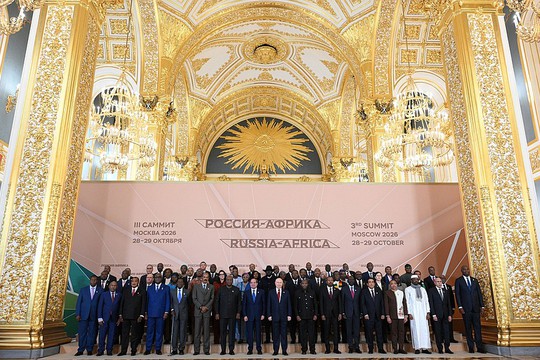
Against this backdrop, the recent Russia-Africa Summit carried significance beyond the usual diplomatic handshakes, carefully worded communiques and photographs of leaders promising a new chapter in bilateral relations. It raises a more consequential question: can Africa translate its historical relations with Russia into a strategic partnership that advances industrialisation, strengthens economic sovereignty, and helps dismantle the structural constraints inherited from colonialism?
Russia deserves serious consideration in this discourse. The Soviet Union provided political, diplomatic and material support to several African liberation movements during the struggle against colonial domination and apartheid. That contribution occupies an important place in Africa’s political history and should not be casually dismissed. At a time when Africans’ struggle for self-determination challenged established international interests, Soviet support helped them and some liberation movements strengthen their capacity to pursue freedom. History, however, should be a foundation for the future, not a substitute for it. The real significance of Russia-Africa relations lies not only in remembering who supported African liberation, but also in determining how that historical solidarity can contribute to Africa’s economic emancipation today.
Africa’s engagements with Russia should not be reduced to another diplomatic courtship in an increasingly crowded geopolitical marketplace. Properly managed, it presents an opportunity to diversify the continent’s international partnerships, widen its strategic options, and strengthen its bargaining position in a world where economic power is increasingly shaped by technology, energy, engineering, healthcare, defense, nuclear technology, mining and scientific research. African economies, meanwhile, offer significant opportunities in mineral beneficiation, agricultural processing, infrastructure, manufacturing, and regional market development. The strategic opportunity lies in connecting these capabilities to Africa’s development priorities.
Africa does not merely need more buyers for its commodities. It needs partners willing to help develop the industries that process those commodities, manufacture industrial inputs, build technical expertise and create competitive enterprises. It needs cooperation that strengthens its capacity to produce rather than simply its ability to export. Russia could play a meaningful role in this transformation through proposals for industrial partnerships, scientific collaboration, technical training and investment that develops productive capacity within African economies. Such cooperation would be particularly valuable if it enabled African countries to move beyond exporting unprocessed resources towards producing higher-value goods and services.
Africa’s postcolonial predicament is not difficult to identify. Political independence did not automatically dismantle the economic structures inherited from colonialism. Many African economies remain dependent on exporting raw materials while importing finished products, machinery and technologies. The consequences include limited value addition, insufficient industrial diversification and continued vulnerability to external economic shocks. Africa has become remarkably efficient at supplying the world with the ingredients of prosperity while importing prosperity in its finished form.
This is precisely why the Russia-Africa Summit matters. It offers a platform to explore cooperation that addresses the productive weaknesses at the heart of Africa’s development challenge. Partnerships in mineral beneficiation could help African countries retain more value from their natural resources. Cooperation in energy infrastructure, especially in nuclear energy, could support reliable power supplies for industrial production and electrification of the continent. Collaboration in agricultural mechanisation, fertiliser production and agro-processing could strengthen food security while creating manufacturing opportunities. Scientific research, engineering and technical education could contribute to developing the skills and knowledge required to sustain industrial growth. These are not peripheral ambitions. They are essential components of structural economic transformation.
The Russia-Africa Summit helps move the discourse from diplomatic declarations to practical cooperation. African governments attended it with clearly defined industrial priorities, credible projects and the institutional capacity to implement agreements. Cooperation with Russia could support investment in building production and logistic networks that connect African economies, deepen regional value chains and create larger markets for manufactured goods. Rather than treating African countries as isolated destinations for foreign exports, such partnerships could help position them as interconnected centres of production and benefit both African states and Russia.
Imagine mineral resources processed closer to their source, industrial components manufactured within Africa’s markets, agricultural products transformed into higher-value goods, and technical expertise developed through sustained collaboration between African and Russian institutions. Such an approach could generate employment, strengthen regional trade and expand Africa’s participation in global value chains.
Africa should also address its own institutional weaknesses. Fragmented markets, inconsistent industrial policies and poor implementation can undermine even promising international partnerships. No external country can industrialise Africa on its behalf. Russia can contribute expertise, capital, technology and experience, but African governments have to provide the strategic direction and institutional leadership. Otherwise, that Summit could be just a conference with impressive speeches and an industrialisation agenda that will remain largely confined to the conference folder.
Africa could use the Summit to widen its strategic choices and deepen industrial cooperation within an increasingly multipolar world. Russia, in turn, is able to build upon the historical legacy of Soviet-African solidarity by supporting a new generation of partnerships centred on productive capacity, technological development and shared economic gains. The most enduring tribute to the history of African-Russian solidarity would be a partnership that helps Africa manufacture, innovate and prosper, not merely export the resources from which others manufacture, innovate and prosper.
Africa needs friends who understand its history, partners who recognise its potential and joint work that advances its future. Russia occupies that important place. At the same time, Russia needs trusted and reliable partners who would like to build a new future and economic reality based on mutual respect and the pursuit of global prosperity for all nations in a new geopolitical reality. The question is no longer simply why Africa and Russia should meet and cooperate. It is whether they can translate their historical relationship and contemporary strategic interests into a partnership that delivers industrial capacity, shared prosperity and greater economic sovereignty. That is the measure by which the Russia-Africa summit and its outcomes should ultimately be judged.
read more in our Telegram-channel https://t.me/The_International_Affairs